Back in June I wrote that the 2027 deadline is not the real risk. The real risk is building the wrong system fast because the deadline is standing behind you with a stopwatch. I still think that. But this week the arithmetic behind that pressure changed, and it did not change in Walldorf. It changed in Brussels.
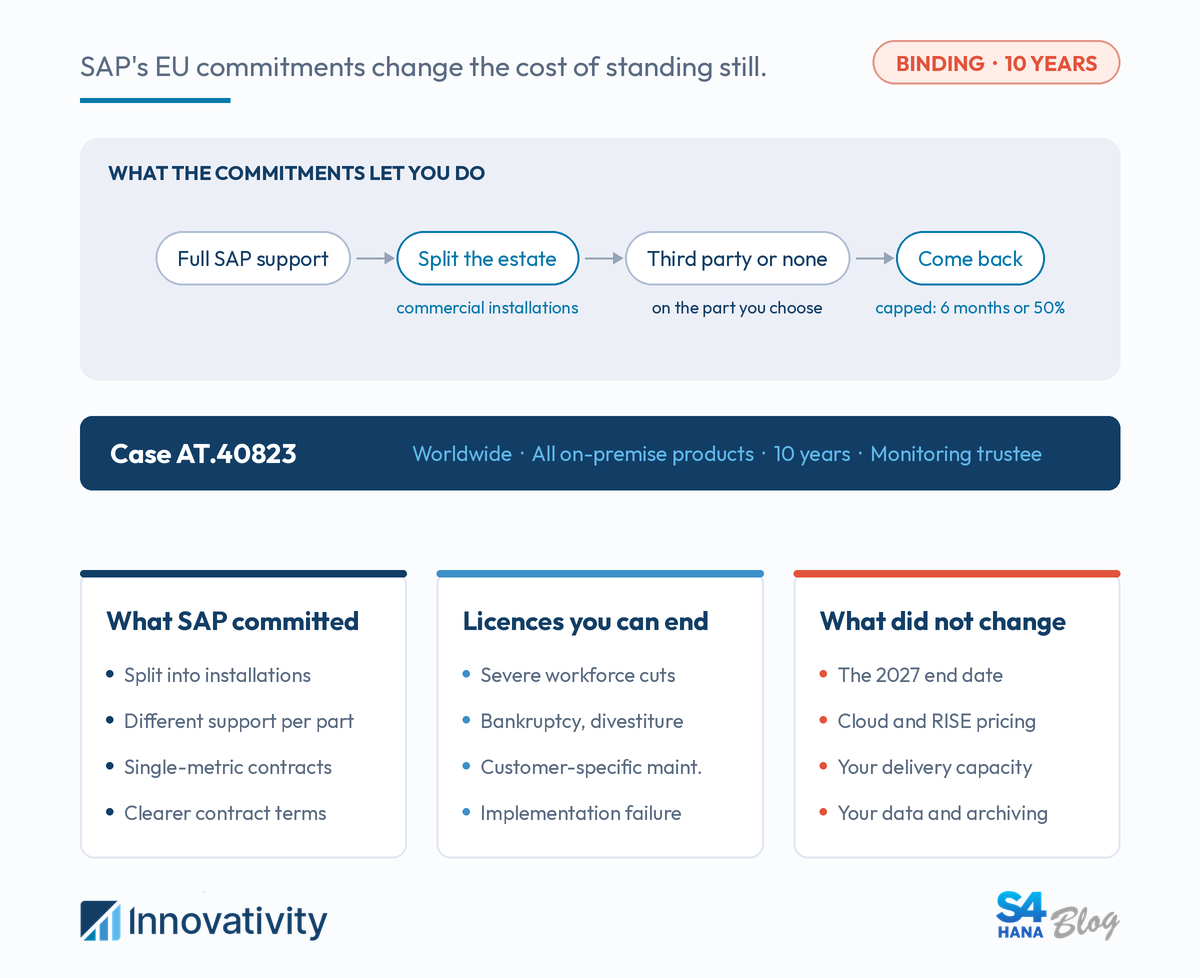
On 9 July the European Commission accepted binding commitments from SAP and closed its competition investigation into SAP’s on-premise maintenance and support practices. Case AT.40823. The commitments apply worldwide, to every SAP on-premise product, for ten years, with an independent monitoring trustee watching.
Now read the list of cases where SAP has committed to let you terminate licences. Severe workforce reductions. Bankruptcy. Divestiture. Products in customer-specific maintenance.
And implementation failure.
Sit with that for a second. The vendor has written the failure case into a document that a regulator enforces. Not into a slide, not into a sales conversation, into a commitment with teeth. You do not add a clause for something that never happens.
What actually changed
Four things matter if you sit in the Finance chair.
You can cut the landscape into pieces and support each piece differently. SAP will give customers a framework for splitting a system landscape into separate parts, called commercial installations, and choosing a different level of SAP support for each one. Different levels. Or no SAP support at all for one of them. Or support from somebody else.
Unused licences can go back. Not freely, and not because you overbought in 2019 and regret it. Only in what SAP calls objectively justified cases, and that is the list above.
Single-metric contracts get broader access. Your maintenance fee is calculated off your licence fee, so the metric your licence is measured in decides how your support bill moves when the business moves. One metric that scales with the business is easier to forecast than a bundle of them.
Coming back to support got a lot cheaper. No administrative fee. And the back-maintenance charge is capped at the lower of six months of fees, or 50% of the fees for the time you were away. A defined set of old products triggers no back-maintenance at all.
That last one is where I want to do some arithmetic, because it is the one nobody will explain to you properly.
The number your CFO will care about
Take a rounded example. Not a client of mine, just clean numbers so you can see the shape.
A licence base of 10 million euro, carrying Enterprise Support at the familiar 22%. That is 2.2 million a year in maintenance. Now suppose you take part of that estate off SAP support for 24 months while you build S/4HANA, and then you want to come back.
The old world: back-maintenance for the full period you were away, plus a reinstatement fee. Two years at 2.2 million is 4.4 million euro, plus the fee, before you have consumed a single OSS note.
The new world: no administrative fee, and the cap is the lower of six months of fees (1.1 million) or 50% of the fees for the time away (50% of 4.4 million, so 2.2 million). The lower of the two is 1.1 million. Your worst case for returning after two years is 1.1 million euro, and you know the number on the day you leave.
Now notice which half of the cap bites, because this is the part I like.
Leave for eight months, and 50% of the fees for the time away is four months of fees, roughly 733 thousand euro. That is below the six-month cap, so the 50% rule sets the price. Leave for two years, and the six-month cap sets it. Anywhere past twelve months off support, the cap goes flat.
The cost of being away stops growing.
Read that sentence again and think about what it does to a business case. Every migration deck I have reviewed in the last three years has a “do nothing” column, and that column is always the one nobody checks. It is padded with an ever-rising support bill and a vague reinstatement penalty, and it exists to make the programme look inevitable. From 9 July, that column has a ceiling. A knowable one.
The one I want to get my hands on
The commercial installation split is the interesting one, and I mean that as a practitioner, not as a commentator. I have been asking for this for years and now it is here!
Because here is the question every SAP customer is going to ask their architect this month: can we just put the old box on cheap support?
You know the box. The ECC production system you are keeping alive after go-live, for statutory retention, for the open items nobody wanted to migrate, for the tax auditor who will come asking in 2031. It is not part of your future architecture. It is part of your obligations.
On paper it is now a perfect candidate for its own commercial installation on no SAP support.
In practice you cannot answer that until you know what is still posting in that system, what is only being read from it, what your Central Finance landscape is still pulling out of it, and what your retention policy actually requires versus what your archiving team assumed it required. Most shops cannot answer that today. So the first thing these commitments create is not a procurement task. It is a data and archiving task, and it belongs to Finance.
Where I am honest with you
I have not seen a contract template, and neither has anyone else writing about this yet.
“Objectively justified” is SAP’s phrase, and SAP is also setting up the clearing structure for customers who dispute how the rules get applied. That is not a small detail. The full text of the commitments sits on the Commission’s competition site under case AT.40823, and that, not SAP’s blog and not mine, is what your legal and sourcing people should be reading this month.
And nothing here moves your 2027 date. Not one day. Mainstream maintenance for ECC ends when it was always going to end. Cloud is explicitly out of scope, so RISE pricing is untouched. I have also not tested how an installation split behaves when a licence metric is shared across boxes, or what it does to a Central Finance setup. That is my next question to SAP.
The verdict
SAP did not do this out of generosity. It did this to avoid a fine, after a two-year push from DSAG and a Commission investigation opened in September 2025. The word “welcomes” in the press release is doing an enormous amount of work.
Take it anyway.
Because the useful part is not the money. The useful part is the candour. A vendor that puts “implementation failure” on a list of justified reasons to hand licences back is a vendor that knows exactly what its own failure rate looks like, and it has now said so in a place where it cannot be walked back for ten years. Use that. Put it in your steering committee pack. It is the best argument for independent design validation I have been handed all year, and I did not even have to make it.
But do not read this as permission to wait. Cheaper to stand still is not the same as safe to stand still. The maintenance bill was never the binding constraint on your migration. Delivery capacity is, and there is no commitment decision coming to fix that.
So: are you going to re-run the “do nothing” column in your business case before you sign the next SOW? Let me know in the comments.
Sources
- SAP News Center, “SAP Welcomes European Commission Decision Concluding the Investigation Into On-Premise Maintenance and Support Policies”, 9 July 2026: https://news.sap.com/2026/07/sap-welcomes-european-commission-decision-concluding-investigation-on-premise-maintenance-support-policies/
- SAP News Center, Stefan Steinle, “Evolving Our Maintenance and Support Practices to Deliver Greater Flexibility for SAP Customers”, 9 July 2026: https://news.sap.com/2026/07/evolving-maintenance-support-practices-greater-flexibility-sap-customers/
- European Commission, “Commission accepts binding commitments by SAP to address competition concerns”, IP/26/1554, 9 July 2026: https://ec.europa.eu/commission/presscorner/detail/en/ip_26_1554
- ERP Today, “SAP’s EU Settlement Gives On-Premise Customers More Room to Maneuver”, 10 July 2026: https://erp.today/sap-eu-settlement-on-premise-maintenance-support/
